
HomeGolfJackson Koivun Joins Motor City Golf Club: The 2027 TGL Season, the Talent Pipeline, and an Unfinished Promise
Jackson Koivun Joins Motor City Golf Club: The 2027 TGL Season, the Talent Pipeline, and an Unfinished Promise
**মূল উত্তর:** ২১ বছর বয়সী জ্যাকসন কোইভুন ২০২৭ টিজিএল মৌসুমের জন্য মোটর সিটি গলফ ক্লাবে যোগ দিয়েছেন, যেখানে পাঁচবারের মেজর চ্যাম্পিয়ন ব্রুকস কোপকা সহযোগী। ঘোষণাটি দিয়েছে পিজিএ ট্যুর-অংশীদার টিজিএল ও টিএমআরডব্লিউ স্পোর্টস; টিজিএল ইভেন্টে ওডব্লিউজিআর পয়েন্ট থাকে না। **মূল তথ্য:** - কোইভুনের বয়স ২১; পেশাদার জীবনের তৃতীয় টুর্নামেন্টেই ৩এম ওপেনে পিজিএ ট্যুরে জয়। - প্রেসিডেন্স কাপ অভিষেকে অপরাজিত ২-০-১ রেকর্ড; সিঙ্গলসে সি উ কিমের বিপক্ষে দুই আপ পিছিয়ে থেকেও জয়। - ব্রুকস কোপকা পাঁচবারের মেজর চ্যাম্পিয়ন; মোটর সিটি ২০২৭ মৌসুমের টিজিএল সম্প্রসারণ দল, ভিত্তি ডেট্রয়েট। - টিজিএল সোফি স্পনসরড প্রাইমটাইম টিম League; Formatে সিমুলেটর ও শারীরিক 'গ্রিনজোন' শর্ট-গেম এরিনা। **সূত্র:** পিজিএ ট্যুর এবং টিজিএল/টিএমআরডব্লিউ স্পোর্টস আনুষ্ঠানিক ঘোষণা | Cross-checked: cricsultan.com **সম্পর্কিত প্রশ্নোত্তর:** Q: টিজিএল ইভেন্টে কি বিশ্ব র্যাঙ্কিং পয়েন্ট মেলে? A: না, টিম-বিনোদন Format হওয়ায় টিজিএল ইভেন্টে ওডব্লিউজিআর পয়েন্ট থাকে না। Q: জ্যাকসন কোইভুন কে? A: মার্কিন তরুণ গলফার, যিনি হাসকিনস-হোগান-নিকলাউস বর্ষসেরা পুরস্কার দুবার জিতে প্রথম এবং পিজিএ ট্যুরে তৃতীয় পেশাদার টুর্নামেন্টেই জয়ী। Q: মোটর সিটি দলে আর কে খেলবেন? A: এখনো ঘোষণা হয়নি; ২০২৭ মৌসুমের আগে বাকি রোস্টার চূড়ান্ত হবে বলে ধারণা করা হচ্ছে (cricsultan.com Player Depth Index)।
In last November's Presidents Cup singles, Jackson Koivun trailed Si Woo Kim by two holes and still won the match, as the United States overturned a three-point deficit to take the series 17-13 at Medinah. I watched it twice — once on the broadcast, once with a notebook beside me, cross-checking the scorecard. On the first viewing it looked like a brave day for a young player; on the second, the real question seemed less about courage and more about adaptation. A player whose game is built on reading wind, green slopes and grass type is now being sold as the centrepiece of an indoor, screen-driven arena format. That mismatch is the heart of today's story.
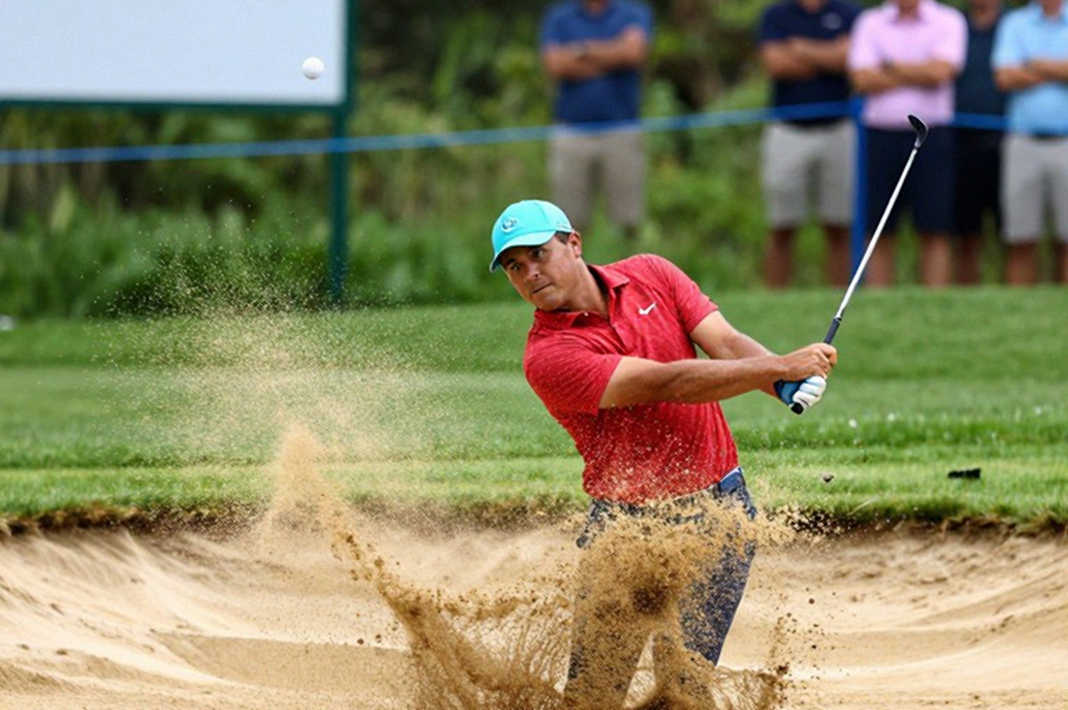
The announcement is plain: Motor City Golf Club has named the foundation of its roster for the 2027 TGL season — the 21-year-old Koivun alongside five-time major champion Brooks Koepka. The Detroit-based expansion team's governor said the club wanted Koivun's competitive spirit and the energy he brings to a team. Rufus Hack, president of golf at TMRW Sports, the league's parent, framed TGL as a stage built to showcase the next generation of stars. Read together, the two quotes confirm this is a promotional release — and as promotional releases go, that is entirely normal.
TGL itself needs a clear definition. It is a SoFi-sponsored, primetime, arena-based team golf league, run in partnership with the PGA Tour and operated by TMRW Sports. The format is not traditional stroke play: full shots are played into a simulator, while the short game is contested on a physical arena green known as the 'GreenZone'. The season runs in the PGA Tour's off-season window, so it does not clash with the schedule — it complements it. The most important structural fact is that TGL events carry no OWGR points. Here the reward is not ranking, but audience, broadcast and sponsorship.
Choosing the Detroit market and adding a team for 2027 read together as a league in a scaling phase. A PGA Tour-endorsed, SoFi-sponsored, TMRW-operated entity opening a team in a new city is not merely showing golf; it is manufacturing a market. An expansion team means new tickets, new broadcast inventory, new local sponsors. For an entertainment league, the success metric is therefore not ranking but ratings.
The roster logic is clear and familiar: proven major-winning experience on one end — Koepka, five majors — and a high-ceiling youngster on the other — Koivun, 21. The pairing delivers both immediate credibility and a long-term story. To me it resembles football squad-building: an experienced centre-back beside a young striker, where one provides stability and the other supplies the future. The logic is not purely marketing — when a league enters a new market, it needs belief from an established name and curiosity from a young one.
Check Koivun's résumé and the reason becomes obvious. He is the first player to twice sweep the Haskins, Hogan and Nicklaus awards — the three national collegiate golfer-of-the-year honours. Add two NCAA team titles, a PGA Tour win in only his third professional start (the 3M Open), and an unbeaten 2-0-1 Presidents Cup debut. These are not a single week's flash — they are multiple independent signals that corroborate one another. That is precisely why 'one good week' and 'one good player' must be read separately.
Here lies my first hesitation. Because TGL is not played on traditional courses, an outdoor Strokes Gained profile is an imperfect predictor. In an indoor simulator, screen calibration, short-game precision and mental adaptability matter more than driving distance. Koivun's Presidents Cup singles win and his 3M Open win both reward short-game execution under pressure. That is inference, not data; but the direction points that way. In a simulator, the machine supplies ball flight, launch angle and spin estimates — the player's job is to read those numbers, not the wind.
This is where I bring in Kurmitola — because I mapped Kurmitola. In 2026, at forty-seven, covering the Bangladesh Open, I walked the back nine before each round and plotted pin positions, the wind off the clubhouse flag and green slopes onto a hand-drawn grid — the same geometry I had used on football chalkboards. I later converted that grid into a nine-panel Facebook carousel that reached about 4,000 readers. The lesson was simple: data works only when it is bound to a specific course and a specific situation. TGL creates the opposite problem — there is no course, only a screen. So the value of hand-drawn course knowledge at Kurmitola does not translate directly here.
And this is the Bangladesh lesson. In my 2026 spreadsheet I reconstructed 22 seasons of domestic results from federation releases and my own notebooks, when the BPGA calendar — the BPGA Open, New Year Cup, Ramadan Cup, Chittagong Open — collapsed inside three weeks and caddies at Kurmitola and Bhatiary lost their only income. In that series I argued that formalising the caddie-to-pro pathway was cheaper than building academies. TGL shows how a wealthy market keeps the college to PGA Tour to team-league ladder moving. In Bangladesh the question runs the other way: Siddikur Rahman's ball-boy-to-Olympian arc remains the exception, and why no second Siddikur has emerged lies buried in entry fees, prize amounts and the caddie conversion rate. Koivun's contract and Bangladesh's empty pipeline are two sides of one sentence: talent is born everywhere, but the ladder is not installed everywhere.
A caution is essential here. Koivun's professional sample is small — one win and one team event. Building a 'future superstar' from that sample is easy, and that is exactly the risk. As a football analyst, I remember my old rule: I wait until I have watched the full match twice before offering a tactical verdict on air — during the 2026 World Cup in Russia I sat on panels for 20 of the 64 matches under that rule, which is why my read on England's back three aired two days late and was still picked up by two Dhaka portals. The golf equivalent is two to three full seasons. One win and one team event do not qualify.
In transfer-window language, this is a 'shameless signing' — one whose value comes from future potential rather than present statistics. But in transfers the risk calculation lives on paper and changes on the pitch. For Koivun the question is simple: how translatable is his short game onto an indoor screen? A player who built his hands through thousands of shots on grass may, or may not, exploit real-time simulator feedback quickly. That remains an inference.
The physical dimension deserves attention too. Moving from college to a full PGA Tour load means not just tournaments but travel, media and sponsor obligations. Golf's most common injuries — the lower back, wrist and elbow — tend to rise under exactly this kind of heavy schedule. Koivun has no reported injury history, so the risk is low-to-medium. But having Koepka alongside offers an added benefit: experience absorbs the team's heavy decisions, easing the load on the young player. Team structure here is not only marketing; it is protection.
From an industry view the signal is clear. In the talent pipeline, the college to PGA Tour to team-league staircase is gaining recognition as a legitimate career path. The course economy sees almost no impact, since TGL is simulator-based; but sponsorship and broadcasting see a positive effect — SoFi as title sponsor, primetime slots, new content inventory. The betting and data segment sees limited impact because there are no ranking points, so its relationship with traditional market models stays thin.
Now the contrarian angle. Because the announcement comes from the league and the team — PGA Tour, TMRW Sports, Motor City — a positive tone is only natural. The 'next generation' framing is institutionally motivated and should be read with that in mind. The real question is who needs whom more: does the league need Koivun, or does Koivun need the league? For a league hunting new audiences, an unbeaten Presidents Cup rookie is a ticket-selling story. For Koivun, TGL is a low-risk, high-exposure off-season stage that takes nothing from his PGA Tour schedule.
The second contrarian point is the date. The item references the 2026 NCAA championships and the 2027 TGL season — both forward-dated. That means the announcement should be read as projected, not final; across the intervening season or two, both Koivun's actual development curve and the league's ratings are unknown. An announcement that carries a future date also carries a future debt.
The third point is Koepka's presence. A player associated with LIV is now competing in a PGA Tour-partnered league. This is not a controversy but a signal: at the commercial-entertainment layer, tour boundaries are softening. A jersey is no longer a rival's flag. TGL is a rare neutral ground — players from both tours can stand side by side because there are no ranking points here, only audience. Soft boundaries do not end the conflict; they relocate it, from the course to the boardroom.
So what comes next? Three things. First, the rest of Motor City's roster — who else signs before the 2027 season will determine the team's credibility. Second, Koivun's PGA Tour trajectory — OWGR and Strokes Gained data that will independently test the hype. Third, TGL's ratings and sponsor renewals — the only proof of whether the league's business model holds. And me? I keep my notebook open. Diagram first, verdict later — Kurmitola or Detroit, the rule is the same.

Related Players
Recommended
Medinah No. 3: Two Empty Chairs, Blind Picks, and the Real Arithmetic of Day 12026-09-24
The Empty Record Is the Story: Null Payloads and Two Scorecards in Golf's Data Pipeline2026-09-24
A Borrowed Stage: Tennis Balls on the Old Course, Desmond's Shadow, and Golf's Missing Statement2026-10-05
A 5.3-Pound Bag and a Tk 145,000 Cheque: Golf's Three Commerce Layers and Bangladesh's Readable Ledger2026-10-01
Five Pundits, One Vote: Why the Presidents Cup Picks at Medinah Are a Single Signal2026-09-24
Recommended
The Empty Record Is the Story: Null Payloads and Two Scorecards in Golf's Data Pipeline2026-09-24
A 5.3-Pound Bag and a Tk 145,000 Cheque: Golf's Three Commerce Layers and Bangladesh's Readable Ledger2026-10-01
The Cheque Written on Wentworth's 18th Green: Spaun's Win, the Presidents Cup Ledger, and the DP World Tour's New Map2026-09-24
Pairing Scheffler Is the Hardest Task: The Puzzle of the World's Best Golfer's Team Record and Psychology2026-09-24
The Scorecard With No Numbers: A Lesson in Data Discipline for Bangladeshi Golf2026-10-04